

Ancestral tools are employed in the creation of DdR sculptures.

Tree that fell, without human intervention, after the hurricane season in the Yucatan Peninsula.
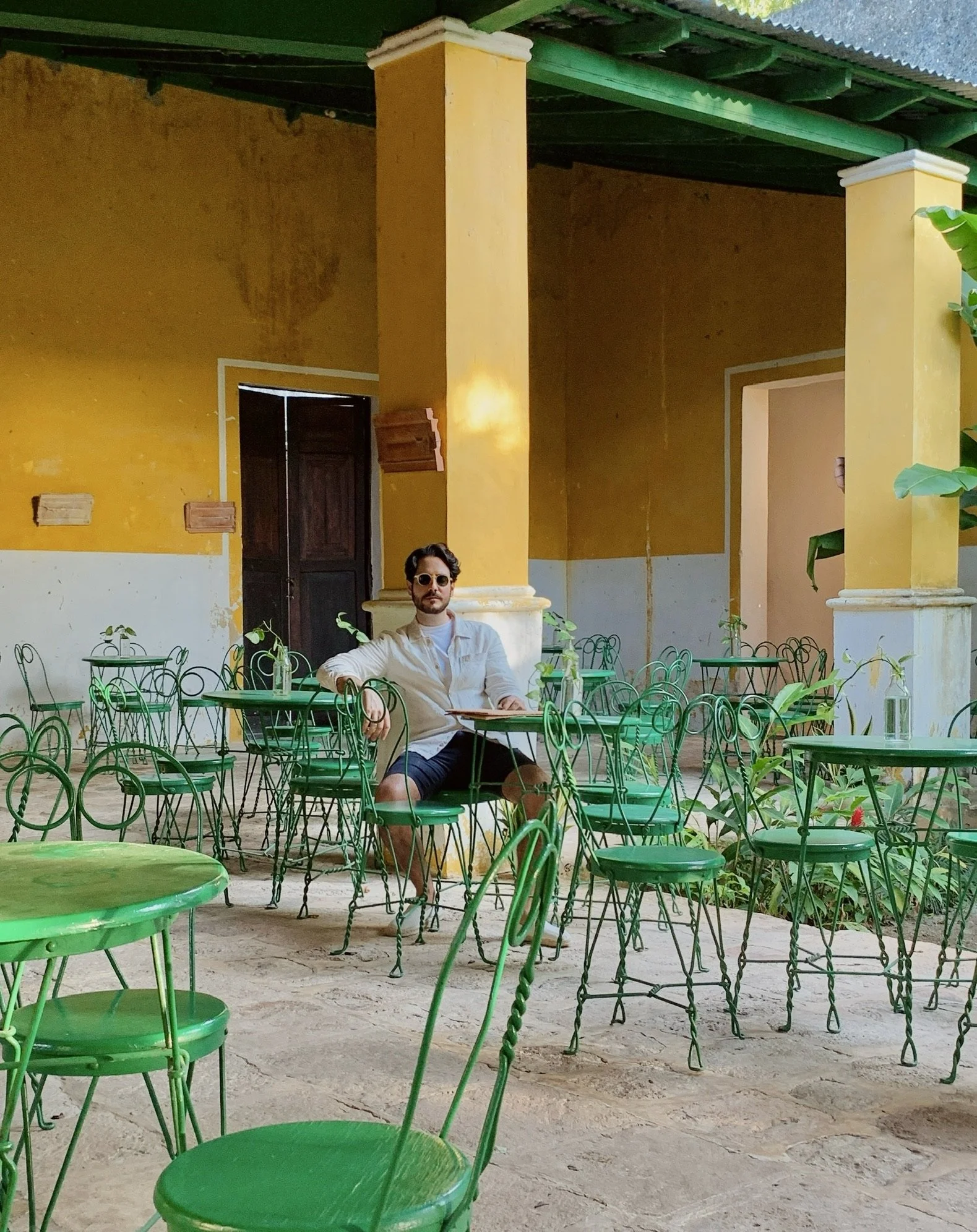
Diego de Romay
Diego de Romay (Mexico/United Kingdom) is a sculptor whose artistic practice is primarily developed from his studio in Bacalar, on the Yucatán Peninsula. A graduate in Ancient History from the University of St Andrews, his formation as a historian informs a practice deeply attentive to the archaic visual language of humanity: from the sculptural abstractions of prehistoric ritual objects to the human and animal forms of Mesoamerican cultures in Oaxaca and the Maya region, De Romay finds a continuity in the relationship between material, symbolism and collective memory. This historical perspective, combined with an intuitive sensibility forged in an environment where spatial thinking and proportion formed part of everyday life, led him to find in organic matter — particularly wood and mineral stone — the territory of his fundamental enquiry.
In formal terms, De Romay’s work operates through subtraction, via the direct carving of solid blocks of hardwoods native to the region (such as tzalam, chechén, katalox) obtained exclusively from fallen trees or reclaimed trunks. The process respects natural drying cycles, incorporating deformations, cracks and tonal changes as constitutive elements of the piece. His surfaces oscillate between the raw and the polished, exposing the internal anatomy of the material while preserving the memory of its bark. In more recent series, he incorporates white limestone and sandstone from the region, as well as controlled carbonisation processes that alter the surface integrity of the wood.
Conceptually, the work is articulated in three bodies that explore, from different angles, the relationship between organic matter, human intervention and permanence. Symbiosis investigates connection (romantic, familial, cellular) through biomorphic forms in which the void functions as an active spatial agent. Anima Arbor Axis proposes the structural rebirth of the fallen tree, and the verticality that was once a condition of growth becomes a condition of presence, resonating with the axial logic of megalithic constructions and the tectonic clarity of Maya architecture. Substrata inverts the geological hierarchy of the Yucatán landscape, where trees grow on a thin layer of soil above limestone bedrock, allowing stone to emerge from wood and collapsing disparate temporal scales into a single sculptural event. A shared question runs through these series, akin to the search for essential form undertaken by Brancusi, Moore, Hepworth and Noguchi: how far can form be reduced before it ceases to sustain tension?
His work has been the subject of international residencies and forms part of private collections in Mexico, the United States, the United Kingdom, Canada, Spain and Japan. His work has been reviewed in publications such as Grazia Magazine, M de Milenio, El Mundo, Excélsior, DH and Hotbook. He actively participates in the formation of new generations as a guest lecturer at UQROO and mentor at the Universidad Politécnica de Bacalar, where he collaborates with local artisans who participate in the production of the works under an equitable profit-sharing model.